
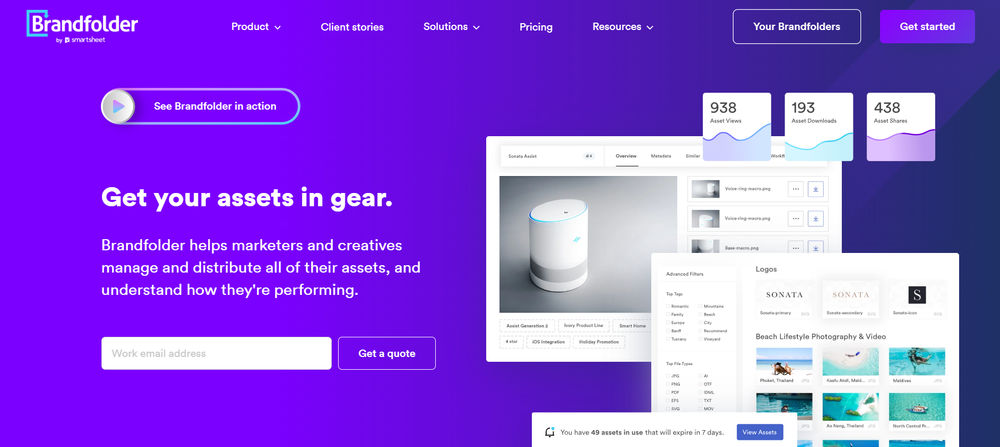
What is Brandfolder?
Brandfolder by Smartsheet is a DAM-first brand asset management platform focused on organizing, managing, distributing, and analyzing digital assets from a central source of truth. It supports branded portals, collections, permissions, metadata, custom fields, AI-assisted tagging and search, Smart CDN delivery, asset analytics, creative workflow, templates, Brandguides, and integrations across marketing and creative systems.
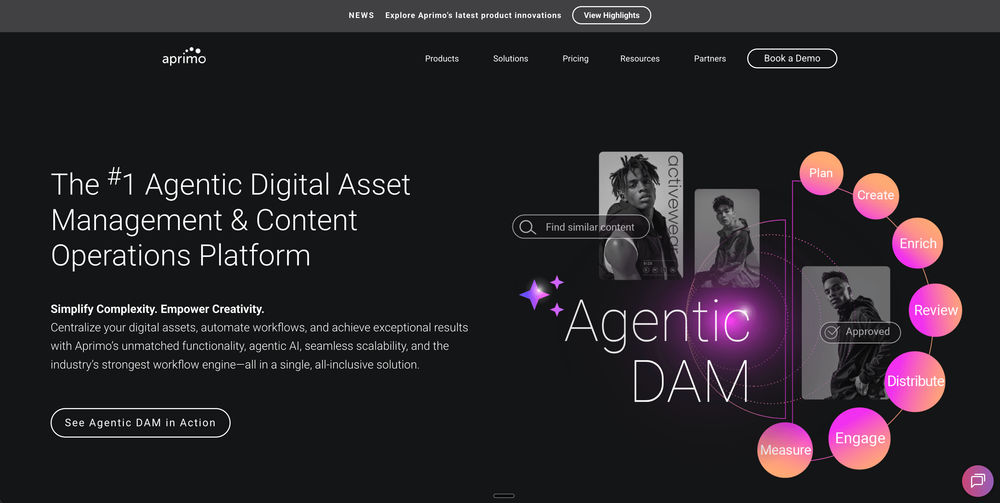
What is Aprimo?
Aprimo is an enterprise digital asset management and content operations platform that combines DAM, AI-powered content automation, workflow and approval management, content planning, marketing resource management, spend management, content intelligence, personalization, and omnichannel asset delivery. Its current Agentic DAM positioning extends beyond asset storage and governance into AI-assisted planning, metadata enrichment, search, compliance review, content creation, transformation, personalization, and distribution.
Brandfolder strengths and weaknesses
Brandfolder strengths
- Good usability for marketing, brand, sales, and creative teams that need quick asset discovery and sharing.
- Strong brand portal and external distribution workflows, including collections, share links, guest access, permissions, and vanity URLs.
- Good DAM foundation for metadata, custom fields, tags, labels, sections, collections, asset availability controls, and user permissions.
- Smart CDN lets teams embed Brandfolder assets across websites, CMS, ecommerce, email, and other channels while keeping assets updateable from the DAM.
- Brand Intelligence adds AI-assisted auto-tagging, OCR/document intelligence, video AI, speech-to-text transcription, scene detection, and asset analytics capabilities.
- Strong fit for Smartsheet customers because Brandfolder is part of the Smartsheet ecosystem and integrates with Smartsheet workflows.
- Good creative enablement features, including templates, Brandguide, content automation, bulk management, proofing, and creative workflow support.
Brandfolder weaknesses
- Pricing is not publicly listed in a simple self-serve table; customers need sales engagement for a quote.
- Advanced capabilities are split across Premium and Enterprise tiers, so features like SSO, asset analytics, document intelligence, video AI, custom automation, granular permissions, vanity URLs, and enterprise creative tooling may depend on plan scope.
- Smart CDN and download formatting are useful, but Brandfolder is not a full developer-first image/video transformation API like ImageKit or Cloudinary.
- Video capabilities are DAM-oriented, including playback, clipping, watermarking, resolution/file-type changes, and Video AI, rather than broad programmable transcoding and adaptive streaming workflows.
- Teams may need onboarding and taxonomy planning because Brandfolder's tagging, custom fields, sections, labels, and collections model can differ from folder-based storage habits.
- Some integrations, automation, permissions, analytics, and enterprise controls may require configuration, admin work, or higher-tier packages.
Aprimo strengths and weaknesses
Aprimo strengths
- Broad enterprise content operations platform combining DAM, workflow automation, reviews, approvals, planning, spend management, content intelligence, personalization, and distribution.
- Strong enterprise DAM foundation with configurable metadata and taxonomy, versioning, collections, Brand Portals and Guidelines, granular permissions, DRM, auditability, and lifecycle governance.
- Extensive AI capabilities including Planning, Librarian, Critic, Compliance, and Production Agents for planning, enrichment, governance, review, transformation, and delivery workflows.
- Strong AI-powered discovery through semantic AI Search, Smart Tagging, Predictive Metadata, Enhanced Captioning, OCR, speech-to-text, reverse image search, similarity matching, and video summarization.
- Supports real-time and predefined image transformation through Public Links, URL parameters, renditions, auto-resizing, Smart Cropping, format conversion, quality controls, and AI Smart Transform.
- Substantially stronger video capabilities than a traditional DAM, including transcoding, trims, adaptive streaming, subtitles, AI transcription and summaries, multilingual subtitle support, clip generation, and video watermarking.
- Strong fit for regulated and governance-heavy organizations through approval workflows, DRM, audit trails, AI Content Detection, Smart Review, and Compliance Agents.
- Global DAM-driven delivery with CDN support, Public Links, URL transformations, edge delivery, custom domains, integrations, and asset-level engagement analytics.
Aprimo weaknesses
- Pricing is custom and not publicly disclosed as a price table; purchasing is sales-led and Aprimo says contracts typically begin with a 12-month duration.
- The platform is broad and highly configurable, which can create a steeper learning curve and more implementation and administration work than simpler DAM products.
- Some of Aprimo's more advanced AI capabilities are packaged through optional offerings such as AI Elite, so the complete AI feature set should not be assumed to be included in every DAM deployment.
- Total cost can rise with users, modules, AI packages, integrations, marketplace connectors, implementation requirements, and adjacent Aprimo products such as Productivity, Plan, Spend, Personalization, or Content Intelligence.
- Image and media delivery are DAM-led rather than developer-first: Aprimo supports powerful URL transformations and delivery, but it is not primarily designed as a programmable image/video processing API platform.
- Video management is capable but is not positioned as a standalone specialist video platform; there is no clear public evidence for features such as AI video smart-cropping, recommendation playlists, seek-preview thumbnails, or deep video-player customization.
- Some delivery infrastructure and ecosystem scenarios use partner CDN or marketplace integrations, so architecture and feature availability can vary by implementation.
Feature Comparison between Brandfolder and Aprimo
Here is a detailed look at how Brandfolder and Aprimo compare across Digital Asset Management, Other AI Capabilities, Pricing, Image Optimization and Transformations, and Video Optimization and Transformations.
Digital Asset Management comparison
Brandfolder is a mature DAM focused on usability, brand governance, external sharing, metadata, collections, permissions, analytics, AI-assisted search, and creative enablement. It supports Brandfolders, sections, labels, collections, asset containers, custom fields, tags, availability/expiration controls, user roles, branded portals, Brandguides, content automation, templates, and integrations.
Aprimo is a mature enterprise DAM and Agentic Content Operations platform with configurable metadata and taxonomy, asset versioning, collections, Brand Portals and Guidelines, granular permissions, DRM, workflows, approvals, annotations, collaboration, analytics, APIs, Public Links, AI-powered search and enrichment, and AI Agents. Its DAM is designed to govern the complete asset lifecycle while connecting assets to planning, production, review, delivery, personalization, and performance.
| Feature | Brandfolder | Aprimo |
|---|---|---|
| Upload and Storage | Centralized upload and storage, including browser upload, bulk upload, API upload, external source import, and asset containers. | Enterprise asset ingestion, bulk upload, cloud storage, global storage and delivery, lifecycle management, and support for images, video, documents, text, prompts, 3D, and other asset types. |
| Metadata Tagging | Tags, custom fields, metadata, labels, sections, controlled fields, and AI-assisted auto-tagging. | Highly configurable metadata and taxonomy plus Smart Tagging, Predictive Metadata, OCR, transcription, captioning, and metadata automation. |
| Version Control | Asset replacement, attachments, merged asset containers, and lifecycle workflows are supported. | Asset versioning, replacement workflows, bulk version uploads, lifecycle controls, and auditability. |
| Brand Portal | Branded Brandfolders, collections, white labeling, vanity URLs, and external sharing workflows. | Brand Portals and Brand Guidelines provide governed self-service access to approved brand content. |
| Collections | Collections organize and restrict subsets of assets for internal or external audiences. | Collections and Collaboration Boards support curated asset sets, sharing, annotations, discussions, and collaborative workflows. |
| Role-based Access | User management, permissions, guest access, privacy controls, and more granular controls on Enterprise. | Granular role-, user-, group-, and asset-level access controls, download permissions, DRM, and controlled sharing. |
| Approval Workflows | Creative workflow, proofing, content automation, templates, and review workflows are available depending on package. | Configurable content review and approval workflows with annotations, markup, side-by-side reviews, workflow automation, and compliance routing. |
| AI Agents | Planning, Librarian, Critic, Compliance, and Production Agents support planning, metadata enrichment, search, review, compliance, content transformation, and production workflows. | |
| AI-powered Search | AI-assisted tags, OCR/document intelligence, suggested search, filtering, pinned searches, and video AI improve discovery. | Semantic and natural-language AI Search, visual similarity, reverse image search, OCR, speech search, Smart Facets, recommendations, and context-based discovery. |
| AI-powered Tagging and Metadata | Auto-tagging, document intelligence, video AI tags, speech-to-text transcription, and metadata enrichment are supported. | Smart Tagging, brand-specific Smart Tag Training, Predictive Metadata, Enhanced Captioning, OCR, speech-to-text, and Librarian Agents automatically create and enrich metadata. |
| AI-powered Content Creation | Content Automation and templates support on-brand content creation, but not broad generative AI editing like ImageKit or Bynder Studio AI. | Production Agents, Smart Actions, Content Coach, Intelligent Content Brief, Smart Transform, and other generative capabilities create copy, briefs, localized variants, and transformed visual content. |
Other AI Capabilities comparison
Brandfolder offers Brand Intelligence for AI-assisted DAM workflows, including auto-tagging, document intelligence/OCR, video AI, speech-to-text transcription, scene detection, people tagging, suggested search, and asset analytics. These capabilities are oriented toward asset discoverability, metadata, governance, and performance insights rather than broad generative media editing.
Aprimo has a broad embedded AI layer covering planning, metadata enrichment, semantic search, content recommendations, video transcription and summarization, content generation, image transformation, compliance review, AI content detection, and agentic workflow automation. Aprimo AI includes Planning, Librarian, Critic, Compliance, and Production Agents, while capabilities such as Smart Transform, Smart Actions, Content Coach, Predictive Metadata, Smart Cropping, and Intelligent Content Brief extend AI across the content lifecycle. Some advanced capabilities may require AI Elite or other package-level enablement.
| Feature | Brandfolder | Aprimo |
|---|---|---|
| Background Removal | Smart Transform supports interactive and rule-based background removal, including automated renditions. | |
| Content Moderation | Governance is supported through permissions, availability controls, usage agreements, view-only assets, and workflows, but not as a dedicated AI moderation suite. | Smart Review, Critic and Compliance Agents, AI Content Detection, and governance workflows can check brand, legal, regulatory, truth-in-advertising, contradiction, and other content risks; this is enterprise content-governance moderation rather than a general-purpose UGC safety API. |
| Generative Fill | Smart Transform supports generative fill/outpainting, canvas expansion, object removal, and other generative edits. | |
| Background Change | Smart Transform can generate, replace, or modify image backgrounds. | |
| Upscale | Smart Transform includes AI-powered image upscaling. |
Pricing comparison
Brandfolder pricing is sales-led and package-based. Its public pricing page describes Premium and Enterprise plans but does not publish a simple price table. Final cost depends on package, users, storage, distribution needs, analytics, automation, permissions, creative tooling, integrations, implementation, and support requirements.
Aprimo uses custom subscription pricing rather than a public price table. Its current pricing model is based primarily on the selected products/modules and number of users, with packages tailored through a sales engagement. Marketplace connectors and integrations may add cost, AI Elite is an optional add-on, and Aprimo says contracts typically start with a 12-month duration. Customer Success is included.
| Feature | Brandfolder | Aprimo |
|---|---|---|
| Free Tier | ||
| Self-serve | ||
| Usage-based Pricing | Pricing varies by plan scope, storage, users, distribution requirements, features, and enterprise needs. | |
| Transparent Pricing | ||
| Enterprise Plans | Premium and Enterprise packages are described publicly, with Enterprise adding automation, granular permissions, organizational controls, creative tooling, BI connector, and vanity URL. | Enterprise DAM and broader Content Operations packages are available, including optional AI and adjacent modules. |
Image Optimization and Transformations comparison
Brandfolder supports DAM-led image management, resizing, cropping, file format conversion, Smart CDN embedding, custom fields, metadata, AI-assisted tagging, and controlled downloads. It is strong for brand-governed image distribution, but less developer-first than ImageKit or Cloudinary for advanced real-time transformations.
Aprimo supports DAM-driven image processing and delivery through predefined renditions, Public Links, URL-based transformations, auto-resizing, dynamic cropping, format conversion, quality controls, Smart Cropping, watermarking, and AI-powered Smart Transform. Public Links can be used to deliver optimized assets directly to websites and downstream systems through global CDN infrastructure. The feature set is strong for enterprise DAM-led omnichannel delivery, although less developer-first than a dedicated media transformation API.
| Feature | Brandfolder | Aprimo |
|---|---|---|
| Real-time Transforms | Smart CDN can format embedded assets on the fly, but transformation scope is narrower than developer-first image APIs. | Public Links support request-time URL transformations including dimensions, crop, format, quality, and other visual transformations. |
| Resize and Crop | Resize, crop, preset crop types, freeform cropping, and width/height changes while preserving aspect ratio. | Dynamic resizing and cropping through Public Links plus manual, automated, API-driven, and AI-assisted crops. |
| Format Conversion | Users can change file type during download or export; bulk resize/convert supports common outputs such as PNG and JPG. | Renditions and URL transformations support output format conversion. |
| Quality Optimization | Smart CDN focuses on high-quality, low-latency delivery, but not the same automatic quality optimization depth as other media processing products. | Public Link parameters can control quality, dimensions, and format; delivery also uses caching and edge optimization. |
| Smart Crop | Cropping and preset crop workflows are supported; public docs do not position it as a broad AI smart-crop API. | Aprimo Smart Cropping automatically detects areas of interest such as faces, objects, and important visual elements. |
| Watermarking | Watermarks can be applied at Brandfolder or asset level for supported image and video formats. | DAM supports watermarking and metadata-/rights-driven controls for protected asset distribution. |
| Responsive Images | Supports resized outputs and CDN embeds, but not a dedicated responsive-breakpoint system. | URL-based resize, crop, quality, and format transformations can produce channel- and device-specific image variants; this is DAM-driven rather than a dedicated frontend responsive-image SDK. |
| CDN Delivery | Smart CDN embeds Brandfolder assets across web, CMS, ecommerce, email, and other channels. | Aprimo lists global storage and delivery, CDN delivery including China, Public Links, edge optimization, and partner CDN integrations. |
Video Optimization and Transformations comparison
Brandfolder supports DAM-based video management, playback, previews, clipping, watermarking, file type and resolution changes, 1080p streaming inside Brandfolder, uploads up to 8K, and Video AI. Its video capabilities are useful for managing and distributing approved video assets, but they are not as broad as ImageKit-style programmable video processing and adaptive streaming workflows.
Aprimo provides enterprise video management within DAM, including storage and preview, transcoding and renditions, video trimming, OCR, speech-to-text, subtitle management, multilingual subtitles, AI-generated video summaries and time-based chapters, clip generation, adaptive streaming, global delivery, analytics, and video watermarking. Aprimo is capable of delivering video directly from DAM, but its video stack remains DAM-centric rather than a standalone programmable video platform.
| Feature | Brandfolder | Aprimo |
|---|---|---|
| Video Transcoding | Video file type and resolution changes are supported; not positioned as a broad programmable transcoding API. | Aprimo DAM supports video transcoding and configurable renditions, including automated and API-triggered rendition generation. |
| Adaptive Streaming | Brandfolder supports video streaming in the DAM, but public docs do not clearly position it as HLS/DASH adaptive streaming like ImageKit or Bynder AVS. | Aprimo documents bandwidth-optimized adaptive streaming directly from DAM. |
| Video Resizing | Users can change video resolution and file type, depending on permissions and feature availability. | Video renditions can change resolution and other output characteristics for channel-specific delivery. |
| Thumbnail Generation | Video previews and thumbnails are supported as part of video asset management. | Aprimo provides DAM thumbnails and previews for records, including rich-media assets, but public documentation does not clearly describe a dedicated configurable video-frame thumbnail-generation feature comparable to specialist video APIs. |
| CDN Delivery | Smart CDN and embed workflows support asset distribution, but video delivery is DAM-led rather than a full video CDN platform. | Adaptive streams and public media can be delivered through Aprimo's global delivery layer and CDN infrastructure while remaining governed by the DAM. |
| Video Smart Crop | ||
| AI-generated Subtitles and Chapters | AI-powered transcription, subtitle management, video summaries, timestamped topic overviews/chapters, and searchable video moments are supported. | |
| Automatic Subtitle Translation | Aprimo documents multilingual subtitles and AI translation capabilities, but public material does not clearly establish a dedicated automatic subtitle-track translation workflow comparable to specialist video localization platforms. | |
| Recommendations and Playlists | ||
| Seek Thumbnails | ||
| Customizable Video Player |
Who should use Brandfolder?
Marketing, brand, creative, sales enablement, ecommerce, and enterprise teams that need an intuitive DAM for governed asset sharing, brand consistency, external distribution, asset analytics, and self-serve content access. Brandfolder is especially strong for non-technical teams that need a usable DAM and branded asset portal, but it is less suited to developer-first, real-time image/video transformation pipelines than platforms like ImageKit or Cloudinary. Visit Brandfolder website.
Who should use Aprimo?
Enterprise marketing, brand, creative, content operations, ecommerce, and regulated-industry teams that need a highly governed DAM connected to content planning, workflows, reviews, approvals, rights management, AI enrichment, AI-assisted content creation, and omnichannel delivery. Aprimo is especially well suited to organizations that want DAM to operate as the system of record for the wider content lifecycle. It now includes meaningful image transformation, intelligent media delivery, and video capabilities, but remains more DAM- and marketing-operations-led than developer-first media platforms such as ImageKit. Visit Aprimo website.
Why consider ImageKit?
ImageKit combines digital asset management with real-time media processing and CDN delivery in a single platform. Pure DAM tools handle organization and governance well but often require a separate image CDN or video processing service when assets need to be optimized and served — with ImageKit, marketing teams can organize, tag, search, share, and collaborate on assets while engineering teams use transformation APIs to resize, crop, convert, optimize, and stream those same assets on demand. Pay-per-use publicly available pricing based on storage and user seats makes it a more economical path than enterprise-only DAM platforms with high fixed seat costs and opaque custom quotes. Read ImageKit's DAM documentation here.